
Strategy
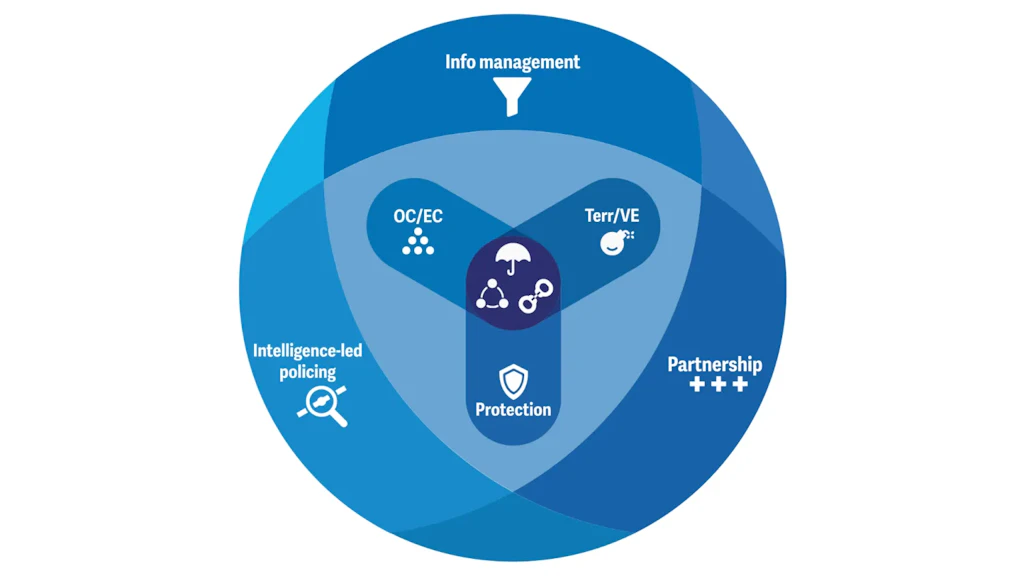
Invia fedpol 2024–27 sets out fedpol’s priorities for the next four years. The strategy is based on fedpol’s legal mandate, comprising a core mandate with three fields of action, three focus areas and three working principles.
Three fields of action
 At the heart of effective crime prevention are three fields of action: prevention; cooperation; repression. These three fields of action apply to three focus areas: organised crime/economic crime; terrorism/violent extremism; protection/security. They are based on three working principles: information management; partnership; intelligence-led policing
This model requires a global approach to combating crime that includes all relevant partners and stakeholders.
Three working principles
 In the face of increasingly complex challenges and limited resources, the principle of intelligence-led policing focuses on the ability to analyse large amounts of information, to use it to create strategic and operational situational pictures and to anticipate future trends in crime. This provides the basis for effective strategic and operational decisions and the efficient use of resources in all fields of action.
 Data compliance: fedpol ensures that it processes data in accordance with the law. Effective data and information management is essential for fighting crime successfully and fulfilling fedpol’s mission. It is crucial that the right information reach the right place at the right time and in the right way.
Data governance: Sustainable data management ensures that information and data are used and processed correctly. Fedpol ensures that the data it handles is secure and private through a mix of technical measures, organisational regulations and internal standards for fedpol staff that handle data. Radicalisation, usually a prelude to violent extremism and terrorism as well as organised and economic crime, frequently remains hidden. Victims often avoid cooperating with the police for fear of reprisals, retaliation, lack of trust in state institutions or because they themselves profit from the offence. The challenge for the police is to detect and investigate such offences nonetheless. Cooperation with the private sector (businesses, NGOs, universities, etc.) and other authorities besides the police (migration offices, commercial registers, land registries, labour inspectorates, food inspections, educational institutions, etc.) has proven useful and will continue.
Three focus areas
 In recent years, Europe has been hit repeatedly by terrorist attacks. The key perpetrators of jihadist-motivated terrorism worldwide are Islamic State and Al-Qaeda or their offshoots. Other Islamist-motivated groups include the Lebanese Hezbollah and the Palestinian Hamas. According to the Federal Intelligence Service (FIS), the threat of terrorist attacks in Europe, including Switzerland, remains high. In addition, the terror threat has become more diffuse, with radicalisation taking place increasingly on the internet and via social media.
The terrorist threat comes primarily from radicalised individuals who commit acts of violence using the simplest methods and means, such as knives or vehicles. Potential perpetrators include individuals – also minors – who have been radicalised in Switzerland, returnees from conflict zones, migrants who are radicalised abroad and arrive in Europe through migration flows and jihadists released from prison. However, radicalised individuals from other ideologies can also commit terrorist attacks, as a look at our European neighbours shows. The most common forms of terrorist activities in Switzerland are terrorist financing and propaganda.
When dealing with violent extremism it is necessary to distinguish between rightwing extremism, left-wing extremism and monothematic extremism. Sometimes the boundaries between violent extremism and terrorism are blurred: actors may feel that they belong to different, contradictory ideologies, making it difficult to clearly categorise them. The actions of violent extremists may have various objectives, depending on the group and its ideology, or be influenced by the situation in Switzerland, Europe and the world. Besides ideology, personal circumstances and mental illness can also play a role. International drug trafficking continues to be the core business of organised crime in Switzerland. The country is not only a major sales market, but also an important transit country for illegal drugs. It is also a manufacturing site for cannabis products and plays a significant logistical role in the transport of large quantities of cocaine
Organised crime groups are also heavily involved in human trafficking, arms trafficking and money laundering. Human trafficking is carried out by groups of very different origin; the networks are mainly transnational and the perpetrators usually have the same ethnic background as the victims. Groups from Asia (China, Vietnam), Southeast Europe and Italy are involved primarily in human trafficking for the purpose of labour exploitation, which affects many sectors and branches of the Swiss economy.
In European comparison and in relation to its size there is a strong presence in Switzerland of criminal organisations from Italy, in particular the 'Ndrangheta, which has several consolidated structures throughout the country. Italian criminal organisations in Switzerland are active in various areas of crime; their main focus is on cocaine trafficking, but they are also involved in arms and human trafficking as well as money laundering.
Criminal groups from Southeast Europe are mainly engaged in the narcotics trade, particularly in cocaine trafficking. They also commit property offences. Nigerian groups are also involved in narcotics trafficking, besides human trafficking and fraud.
Other domestic criminal groups include motorcycle gangs. The gangs fight each other over influence and are often involved in violent offences, including narcoticsand weapons-related crime.
In addition, a number of groups are active in Switzerland that are not based in the country. They often come from European countries such as France, the Netherlands, Belgium and Romania and travel to Switzerland specifically for the purpose of committing offences. Their repertoire includes blowing up ATMs or robbing gun or jewellery shops. Immediately after the act, they retreat across the border.
Many forms of crime are on the increase, for example economic crime, particularly insider trading and market or price manipulation, and cybercrime. Cybercrime is mostly property crime committed using digital means and is usually considered a form of organised crime. The perpetrators operate mainly from abroad, are well organised and work according to a division of tasks.
Paedophile crime is also on the rise, as demonstrated by the ever-growing number of reports received from the National Center for Missing & Exploited Children (NCMEC). fedpol triages these reports and forwards them to the cantons for follow-up action.
Switzerland’s financial centre continues to be affected by the infiltration of illegal money, as reflected in the steady rise of suspicious activity reports to the Money Laundering Reporting Office Switzerland (MROS). Money laundering is often linked to organised crime, particularly drug trafficking. The most frequently reported predicate offences are fraud, followed by forgery. Internationally active Swiss companies also see themselves repeatedly confronted with accusations of corrupting foreign public officials. All these cases lead to considerable reputational damage for Switzerland as a business location and financial centre. fedpol plays a central role at home and abroad in protecting democratic institutions. This includes ensuring the safety of individuals (federal magistrates, members of the Federal Assembly, employees of the Federal Administration who are at risk, persons protected under international law) and the security of buildings (federal buildings and diplomatic missions)
The increasing polarisation of Swiss society in recent years is changing the security landscape and having a fundamental impact on fedpol's protection mandate. Not only are threats against federal councillors increasing both in number and intensity, members of parliament are also subject to ever more hate speech.Threat analysis and management are therefore increasingly important. fedpol continuously monitors the situation and takes the necessary measures in collaboration with the cantonal police forces to ensure the safety of people and buildings in line with individual needs of each. In addition to specific protective measures, fedpol also provides support and advice to those in need of protection as well as to federal administrative units and foreign diplomatic missions in Switzerland.
Switzerland is a prime location for international organisations, conferences and events. Its reputation as a safe country for high-level international exchanges is thanks in no small part to fedpol: together with its federal and cantonal partner authorities, fedpol assesses the security situation for each event and implements the necessary protective measures for the relevant locations and for individuals afforded protection under international law.
International commercial air traffic is of major importance for the economy and tourism. Security officers trained and deployed by fedpol work together with local authorities at high-risk destinations abroad to ensure security both on the ground and on board Swiss aircraft.
In order to prosecute crime, the prosecution authorities depend on witnesses who are willing to testify. Where a witness may be in danger as a result of their testimony and procedural protective measures are no longer sufficient, the cantonal public prosecutor's offices or the Office of the Attorney General of Switzerland can apply to fedpol for the inclusion of a witness in a protection programme, which enables their co-operation in criminal proceedings. Witness protection is an important part of combating serious crime, terrorism and criminal organisations and is part of the international standard in fighting crime.